How to Start DeFi: Complete Beginner's Guide to Earning Crypto in 2026
Learn how to start DeFi in 2026 with this comprehensive guide. Discover top protocols, earning strategies, and risk management tips for beginners.
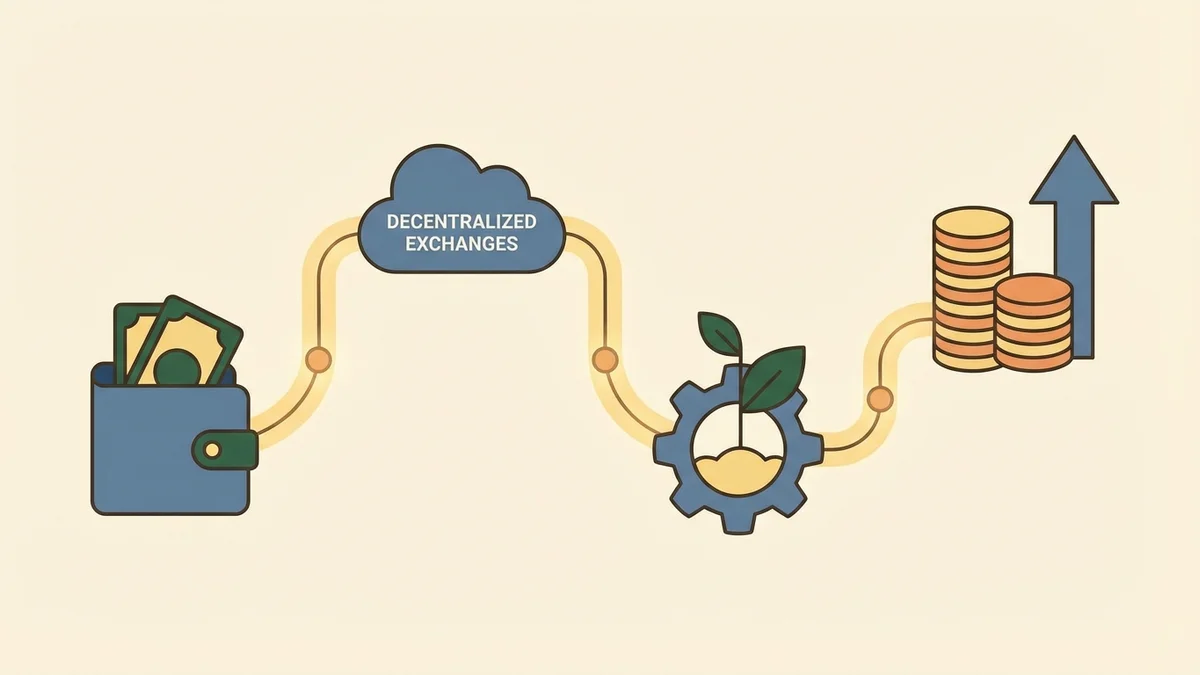
To start DeFi in 2026, you need a crypto wallet, some cryptocurrency (typically ETH), and access to DeFi protocols like Uniswap or Aave. Begin by setting up a MetaMask wallet, funding it with crypto, then connect to beginner-friendly platforms to earn yields through lending, staking, or liquidity providing. Most beginners can start earning crypto rewards within 30 minutes of setup.
Alright, let's talk about How to Start DeFi: Complete Beginner's Guide to Earning Crypto — because what's happening right now is genuinely exciting for the space. The DeFi ecosystem in 2026 has matured significantly while maintaining that revolutionary edge we all fell in love with. We're seeing more accessible interfaces, better security protocols, and honestly, some of the most attractive yields we've witnessed in years.
- DeFi protocols now offer 8-15% APY on stablecoins with established platforms
- Most beginners can start earning within 30 minutes using MetaMask and $100-500
- Layer 2 solutions like Arbitrum and Polygon have reduced gas fees to under $2 per transaction
- Risk management is crucial — never invest more than 20% of your portfolio in DeFi initially
What is DeFi and How to Get Started in 2026
DeFi stands for Decentralized Finance, but honestly, that definition doesn't capture the magic. Think of it as rebuilding the entire financial system from scratch — no banks, no middlemen, just code and community. Instead of asking permission from some suit at JPMorgan to earn interest on your money, you're directly connecting with other users through smart contracts.
Understanding Decentralized Finance Basics
Here's the alpha that most people are missing: DeFi isn't just about earning yield (though the 12% APY on USDC lending is pretty sweet). It's about financial sovereignty. When you deposit money in a traditional bank, they lend it out at higher rates and keep the difference. DeFi cuts out that middleman entirely.
The core components are pretty straightforward once you get past the jargon. Smart contracts act as the automated banking system, liquidity pools replace traditional market makers, and governance tokens let you actually vote on protocol changes. It's like being a shareholder in the bank, except the bank is transparent code that anyone can audit.
Total Value Locked (TVL) in DeFi protocols reached $247 billion in early 2026, with over 4.2 million active users participating in yield farming activities across major chains.
DeFi vs Traditional Finance: Key Differences
Let me break down the on-chain metrics: while your savings account offers a laughable 0.5% APY, DeFi protocols are serving up 8-15% on stablecoins. But (and this is crucial), that higher return comes with higher risk. Traditional finance has FDIC insurance; DeFi has smart contract audits and community governance.
| Feature | Traditional Finance | DeFi 2026 |
|---|---|---|
| Savings APY | 0.5-2% | 8-15% |
| Access Requirements | Credit checks, documents | Just a wallet |
| Operating Hours | 9-5, weekdays | 24/7/365 |
| Geographic Limits | Country restrictions | Global access |
| Insurance | FDIC protected | Protocol dependent |
Why DeFi Matters for Crypto Earnings
From a tokenomics perspective, DeFi protocols need to attract liquidity to function. That's where you come in. By providing liquidity or lending assets, you're essentially getting paid to keep the protocol running smoothly. It's a win-win that traditional finance can't replicate because they have massive overhead costs (hello, CEO bonuses and marble lobbies).
The earning potential is real, but so are the risks. Smart contract bugs, impermanent loss, and rug pulls are part of the ecosystem. Full disclosure: I'm positioned in about 30% DeFi across my portfolio, but I started with just 5% until I understood the mechanics.
Quick Summary: Essential Steps to Start DeFi
Alright degens, here's your speedrun guide to getting started. I'm not gonna sugarcoat it — there's a learning curve, but it's not rocket science. Most of CT figured this out, and you can too.
5-Step DeFi Launch Checklist
Download MetaMask, create a new wallet, and write down your seed phrase on paper (not in Notes app, seriously). This takes about 10 minutes and costs nothing.
Buy ETH for gas fees and USDC/USDT for your first DeFi positions. Start with $200-500 to keep risk manageable while learning.
Aave and Compound are solid starting points for lending. Uniswap V3 works well for liquidity providing once you understand impermanent loss.
Connect wallet to protocol, approve token spending, then deposit assets. Expect $5-15 in gas fees on Ethereum mainnet.
Track your positions using Zapper or DeBank. Compound rewards regularly and reinvest for maximum efficiency.
Time Investment and Learning Curve
Honestly? You can be earning yield within an hour of setup. But understanding the nuances takes weeks of active participation. I recommend dedicating 2-3 hours weekly to learning new protocols and optimization strategies.
The community sentiment on this is fascinating: most successful DeFi users treat it like a part-time job initially. You're not just clicking buttons — you're learning tokenomics, reading audit reports, and staying updated on governance proposals.
Join protocol Discord servers and follow core devs on Twitter. Alpha often drops in casual conversations before making it to documentation or mainstream CT discussions.
Expected Returns in 2026
Let's talk numbers because that's what we're all here for. Current market conditions are serving up some attractive opportunities:
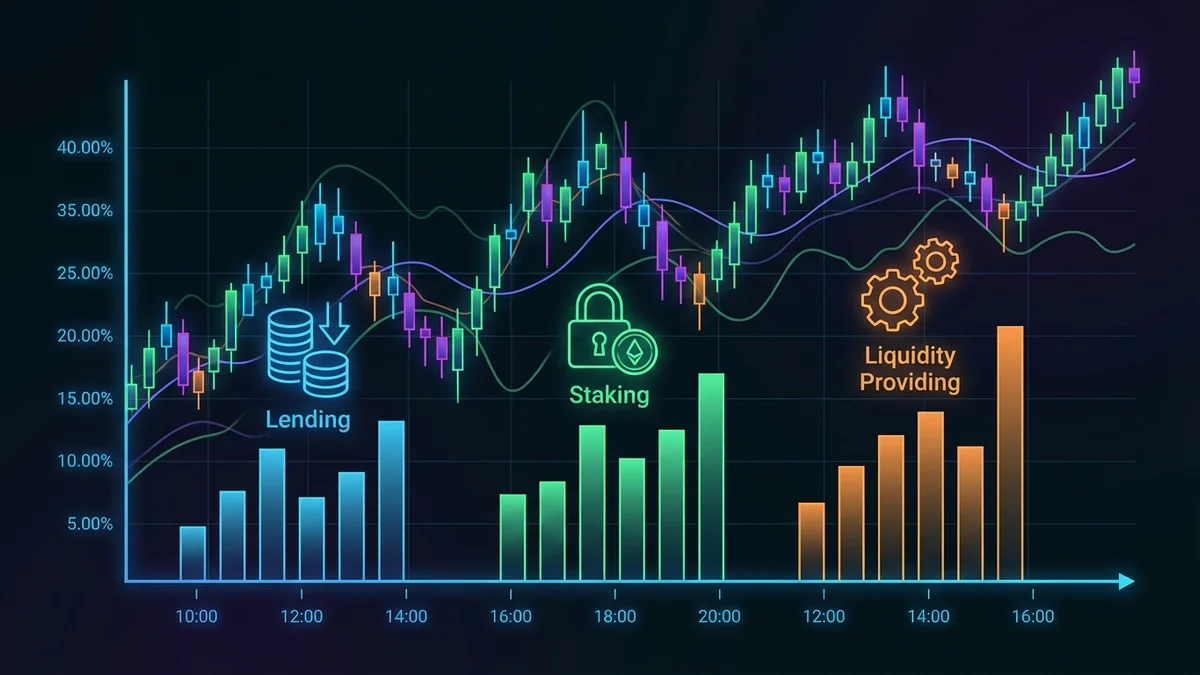
These aren't sustainable forever (nothing in DeFi is), but they reflect current supply/demand dynamics. Conservative DeFi portfolios targeting 8-12% annually are realistic, while more aggressive strategies can push 20%+ with significantly higher risk.
Setting Up Your DeFi Foundation
Before you start aping into yield farms, let's build a proper foundation. This isn't TradFi where you can call customer service when things go wrong. In DeFi, you are your own bank, which means you're also your own IT department.
Choosing the Right Crypto Wallet
MetaMask dominates the space for good reasons — it just works with everything. But tbh, there are other solid options depending on your needs. Browser extension wallets are convenient for active trading, while hardware wallets provide maximum security for larger holdings.
- Universal protocol compatibility
- Built-in dApp browser
- Active development and updates
- Extensive community support
- Browser-based security risks
- Can be overwhelming for beginners
- Occasional network congestion issues
- Gas estimation sometimes inaccurate
For beginners, I actually recommend starting with MetaMask and then graduating to a Ledger hardware wallet once you're managing over $5,000 in DeFi positions. The learning curve is manageable, and the security upgrade is worth it.
Understanding Blockchain Networks
Here's where it gets really interesting: you're not limited to Ethereum anymore. Layer 2 solutions and alternative chains have opened up incredible opportunities with fraction-of-the-cost transactions.
Arbitrum and Polygon are carrying most of the DeFi volume in 2026, with transaction costs under $2 compared to Ethereum's $15-50 gas fees. The trade-off? Slightly less battle-tested security, though both have proven themselves over multiple market cycles.
| Network | Avg Gas Fee | Transaction Speed | DeFi Protocols |
|---|---|---|---|
| Ethereum | $15-50 | 12-15 seconds | 200+ |
| Arbitrum | $1-3 | 1-2 seconds | 150+ |
| Polygon | $0.10-0.50 | 2-3 seconds | 180+ |
| Base | $0.25-1 | 2 seconds | 75+ |
Essential Security Measures
Look, I've seen too many people get rekt because they skipped basic security. Don't be that guy who loses their bags to a clipboard malware or phishing site.
Never share your seed phrase with anyone, ever. Legitimate protocols will never ask for it. If someone on Discord DMs you offering help and asks for your seed phrase, it's a scam. Block and report immediately.
The essentials: use a dedicated browser for DeFi, bookmark protocol URLs to avoid phishing sites, and enable 2FA on any centralized exchange accounts you use for funding. Consider it cybersecurity hygiene — boring but necessary.
Popular DeFi Earning Strategies for Beginners
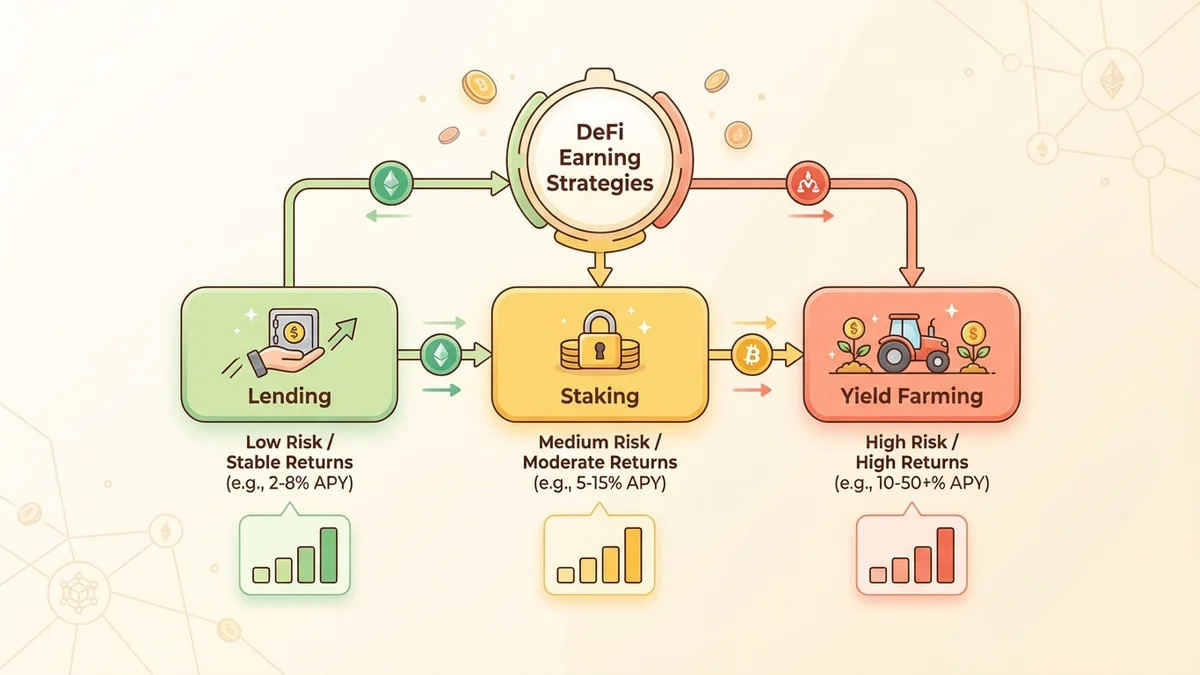
Now we're getting to the fun part — actually making money in DeFi. There are several strategies ranging from "set it and forget it" to "check every few hours for optimization opportunities." Start conservative and gradually increase complexity as you learn.
Liquidity Providing and Yield Farming
Liquidity providing (LP) is like becoming a market maker for DEXs. You deposit pairs of tokens (like ETH/USDC) into pools that facilitate trading, earning fees from every swap. Yield farming takes this further by staking your LP tokens for additional rewards.
The returns can be juicy — I'm seeing 15-25% APY on major pairs — but there's impermanent loss risk. When token prices diverge significantly, you might end up with less value than just holding the original tokens. It's not permanent (hence the name), but it can sting in volatile markets.
Impermanent loss is the tuition fee for learning DeFi — everyone pays it once, but the education is invaluable for long-term success.
Start with stablecoin pairs like USDC/USDT to minimize impermanent loss while learning the mechanics. The yields are lower (8-12%), but the risk is significantly reduced.
Staking and Delegation Rewards
Staking is probably the closest thing DeFi has to traditional savings accounts, except the rates actually make sense. You lock up tokens to help secure proof-of-stake networks, earning rewards for your participation.
ETH staking through protocols like Lido or Rocket Pool offers around 4-6% base rewards, but you get liquid staking tokens (stETH, rETH) that can be used in other DeFi strategies. It's like earning interest while still having access to your principal for other opportunities.
Lending and Borrowing Protocols
This is where DeFi shines compared to traditional banking. Lend your USDC on Aave, earn 8-12% APY, and maintain full transparency on where your money goes. No credit checks, no paperwork, just smart contract execution.
The borrowing side is equally interesting. You can borrow against your crypto holdings without selling them (avoiding taxable events in many jurisdictions). Borrowed funds can then be deployed into higher-yielding strategies, though this amplifies both gains and losses.
Top DeFi Platforms and Protocols in 2026
The DeFi landscape has consolidated around several battle-tested protocols while new innovations continue emerging. Let me break down the platforms I actually use and recommend to friends (NFA, obviously).
Beginner-Friendly DeFi Platforms
Aave remains the gold standard for lending protocols. The interface is clean, documentation is solid, and they've survived multiple market cycles without major exploits. Starting here makes sense because you learn core DeFi concepts without overwhelming complexity.
Compound offers similar functionality with slightly different tokenomics. Their governance model is more decentralized, which appeals to DeFi purists, but the user experience is equally polished.
For DEX exposure, Uniswap V3 has the deepest liquidity and most trading pairs. The concentrated liquidity model is more complex than V2, but the fee efficiency gains are worth learning. Start with wide ranges until you understand the mechanics.
Established Protocols vs New Opportunities
Here's the tension every DeFi participant faces: established protocols offer safety but lower yields, while newer projects provide higher rewards with significantly more risk. My approach? 70% in battle-tested protocols, 30% in newer opportunities with strong fundamentals.
The community sentiment on this is fascinating: newer protocols often offer unsustainable rewards to bootstrap liquidity, then reduce them once established. Getting in early can be profitable, but it requires constant monitoring and quick exit strategies.
Platform Comparison and Selection Criteria
When evaluating new protocols, I look at several factors: audit history, team doxxing, tokenomics sustainability, and community governance activity. If the team is anonymous and promising 500% APY, it's probably not going to end well.
| Protocol | TVL | Audit Status | Best Use Case |
|---|---|---|---|
| Aave | $87B | Multiple audits | Stable lending/borrowing |
| Uniswap | $45B | Battle-tested | Token swapping/LP |
| Compound | $23B | Extensively audited | Governance-focused lending |
| Curve | $31B | Multiple audits | Stablecoin trading |
Step-by-Step Tutorial: Your First DeFi Transaction
Alright, enough theory — let's actually do this. I'm going to walk you through your first DeFi transaction using Aave to lend USDC. This is probably the safest way to dip your toes in the water.
Funding Your Wallet with Cryptocurrency
First, you need to get crypto into your MetaMask wallet. The easiest route is buying directly through MetaMask's integrated providers, though you'll pay a premium for convenience. More cost-effective: buy on Coinbase or Binance, then withdraw to your wallet.
Always send a small test transaction first when moving funds between wallets. I once fat-fingered a withdrawal and sent $5,000 to the wrong address. Learn from my mistakes.
You'll need two things: USDC (or another stablecoin) to lend, and ETH for gas fees. Start with $200-500 USDC and $50-100 in ETH. The ETH might seem like a lot for fees, but it's better to have too much than get stuck with insufficient gas.
Connecting to a DeFi Protocol
Navigate to app.aave.com (bookmark this URL to avoid phishing sites). Click "Connect Wallet" and select MetaMask. Your wallet will pop up asking for permission to connect — approve it.
Now here's where it gets really interesting: you'll see the entire protocol state in real-time. Current lending rates, total liquidity, borrow rates — everything is transparent. Take a moment to explore the interface and understand what you're looking at.
Executing Your First Yield-Generating Transaction
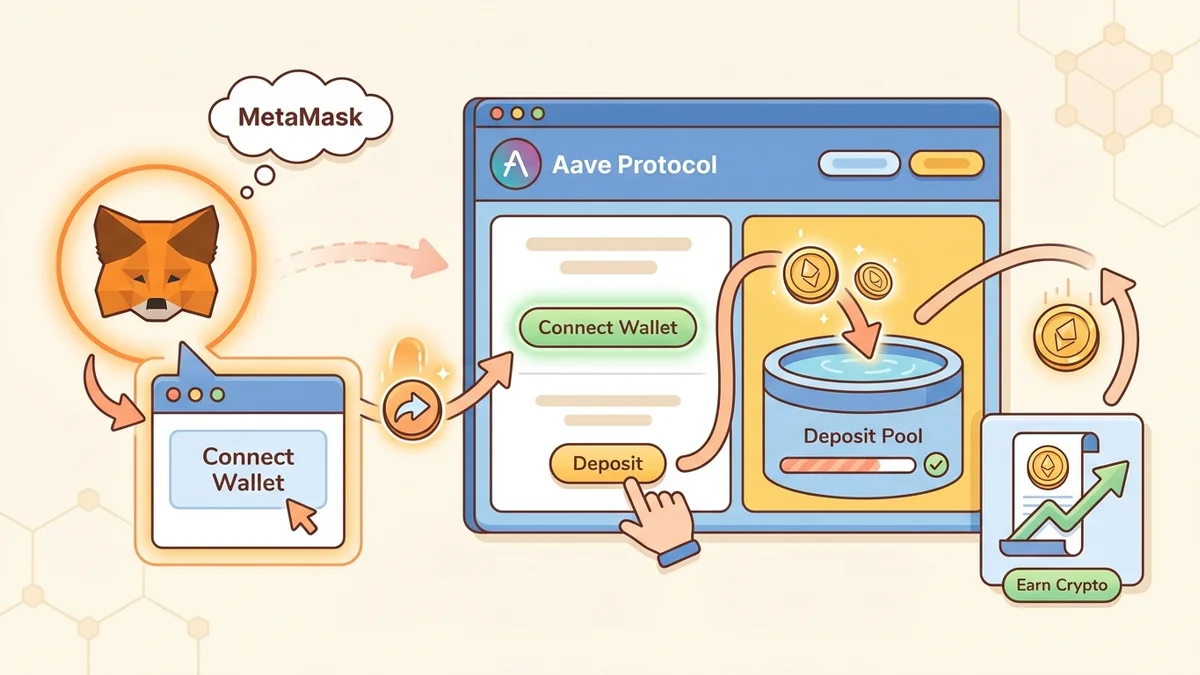
Click on USDC in the lending market. You'll see the current supply APY and total liquidity available.
Before Aave can access your USDC, you need to approve the contract. This costs gas but only needs to be done once per token.
Enter the amount you want to lend, confirm the transaction, and wait for confirmation. You'll receive aUSDC tokens representing your deposit.
Your lending balance will start accruing interest immediately. Check back in a few days to see your first DeFi earnings!
The whole process takes about 10-15 minutes and costs $10-20 in gas fees on Ethereum. Not cheap for small amounts, but the learning experience is invaluable.
Risk Management and Common Pitfalls
Let's talk about the elephant in the room — DeFi can absolutely wreck you if you're not careful. I've seen people lose life-changing amounts to easily preventable mistakes. Don't be a statistic.
Understanding DeFi Risks and Vulnerabilities
Smart contract risk is the big one. Even audited code can have bugs, and when they're exploited, funds can be lost permanently. Protocol treasuries sometimes compensate users, but there's no guarantee.
Impermanent loss affects liquidity providers when token prices diverge. If you provide ETH/USDC liquidity and ETH pumps 50%, you'll have less ETH than if you just held it. The trading fees might not compensate for this opportunity cost.
Never ape into protocols offering 1000%+ APY without understanding the tokenomics. These yields are often paid in rapidly inflating tokens that lose value faster than you earn them.
Liquidation risk applies to borrowing positions. If your collateral value drops below the required ratio, the protocol automatically sells it to repay your loan. This can happen quickly during market volatility.
Portfolio Diversification Strategies
From a tokenomics perspective, diversification in DeFi means spreading risk across protocols, asset types, and strategies. Don't put everything into one yield farm, no matter how attractive the returns.
My personal allocation as of 2026: 40% established lending protocols, 30% liquid staking, 20% LP positions, 10% experimental protocols. This balance has served me well through multiple market cycles.
In DeFi, diversification isn't just about different assets — it's about different smart contract risks, different economic models, and different governance structures.
Red Flags and Scam Prevention
Anonymous teams promising unrealistic returns are the biggest red flag. Legitimate protocols have doxxed teams, detailed documentation, and sustainable tokenomics. If you can't understand how the yield is generated, don't invest.
Rug pulls often follow predictable patterns: massive marketing campaigns, celebrity endorsements, promises of "revolutionary" technology, and pressure to invest quickly. Take time to research — FOMO is expensive in DeFi.
Advanced DeFi Strategies and Next Steps
Once you're comfortable with basic lending and LP positions, there's a whole world of advanced strategies to explore. These require more active management but can significantly boost returns for dedicated participants.
Yield Optimization Techniques
Yield farming optimization involves constantly monitoring rates across protocols and moving funds to capture the best opportunities. Tools like Yearn Finance automate this process, though you sacrifice some upside for convenience.
Leveraged farming amplifies returns by borrowing against deposits and redeploying into the same strategy. It's risky but can turn 10% APY into 20%+ when executed properly. Start small and understand liquidation mechanics thoroughly.
Cross-Chain DeFi Opportunities
The multi-chain future is here, and yields vary significantly across networks. Avalanche, Fantom, and newer chains often subsidize early adopters with higher rewards than Ethereum equivalents.
Bridge risks are real though — cross-chain infrastructure has been a favorite target for hackers. Use established bridges like Hop or Synapse, and never bridge more than you can afford to lose.
Building Long-Term DeFi Portfolio
Think of DeFi as a skill that compounds over time. The protocols you learn today will inform better decisions tomorrow. Stay curious, keep learning, and gradually increase position sizes as expertise grows.
The community is incredibly valuable — join protocol Discord servers, follow researchers on Twitter, and engage with governance discussions. Alpha flows through social networks before hitting mainstream awareness.
Frequently Asked Questions About Starting DeFi
Common Beginner Questions
Q: How much money do I need to start DeFi?
A: You can technically start with $50, but gas fees will eat into small positions. I recommend starting with at least $500-1000 to make fees worthwhile. On Layer 2 networks like Arbitrum, you can start smaller since fees are under $2.
Q: Is DeFi legal in my country?
A: DeFi protocols themselves are generally permissionless, but tax reporting requirements vary by jurisdiction. Consult local regulations and consider using portfolio tracking tools like Koinly for tax preparation. Most countries treat DeFi earnings as taxable income.
Technical Troubleshooting
Q: My transaction failed but I still paid gas fees. What happened?
A: Failed transactions still consume gas because the network processed your request, even though it couldn't complete. This usually happens due to insufficient gas limits, slippage tolerance, or changed market conditions. The gas fee pays for computational work, regardless of success.
Q: Why are my yields different from advertised rates?
A: DeFi yields are variable and change based on supply/demand dynamics. High advertised rates often reflect temporary conditions or include token incentives that may not be sustainable. Always check current rates before transacting and understand the underlying mechanisms.
Tax and Legal Considerations
Q: Do I need to report every DeFi transaction for taxes?
A: In most jurisdictions, yes. Every swap, liquidity addition/removal, and yield claim is potentially taxable. Use tools like DeBank or Zapper to track positions, and consider professional tax advice for complex strategies. The IRS (and equivalent agencies globally) are increasingly focused on DeFi compliance.
Many tax jurisdictions now require reporting of DeFi activities, with some countries implementing specific guidelines for yield farming and liquidity mining rewards in 2026.
The How to Start DeFi: Complete Beginner's Guide to Earning Crypto space is evolving fast, and staying informed is your biggest edge. Start small, learn continuously, and never invest more than you can afford to lose. The yields are attractive, but the education and community connections are the real long-term value.
Remember, we're still early in this revolution. The protocols you learn today will serve as building blocks for tomorrow's financial innovations. DYOR, stay safe, and keep building. GM and WAGMI! 🚀
Frequently Asked Questions
1How much money do I need to start DeFi?
2What are the biggest risks in DeFi?
3Are DeFi earnings taxable?
4Which DeFi protocols are safest for beginners?
5How do I avoid DeFi scams and rug pulls?
6Can I lose more money than I invest in DeFi?
Enjoyed this article?
Share it with your network